

“A Metropolitan Area Yet Medically Underserved”… Incheon Speaks with One Voice, Proposes Establishment of a Public Medical School to the Presidential Office
- 글번호
- 422581
- 작성일
- 2026-04-09
- 수정일
- 2026-04-09
- 작성자
- 홍보과 (032-835-9490)
- 조회수
- 95
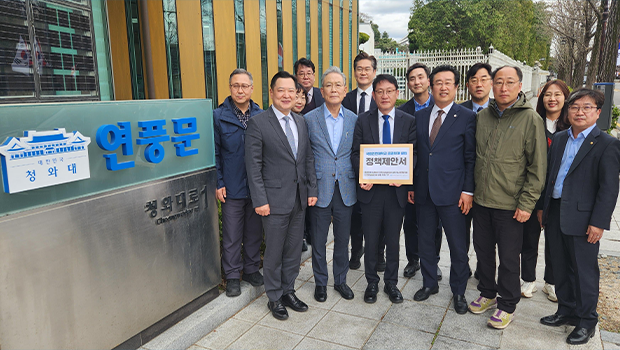
Incheon Speaks with One Voice, Proposes Establishment of a Public Medical School to the Presidential Office
- Presents a collaborative model involving government, local authorities, universities, public healthcare, and civil society… formally requests policy adoption and consultative body formation
- “Incheon is ready”… immediate implementation possible upon policy decision
A policy proposal to establish a public medical school at Incheon National University to address Incheon’s structural healthcare vulnerability has been officially submitted to the Presidential Office.
A group associated with Incheon National University visited a government office on March 31 and held discussions with officials, during which they presented related information.
A total of 18 participants, including representatives from Incheon civil society, the Incheon Metropolitan Government, Incheon National University, and the Incheon Medical Center, attended the meeting to explain the necessity and implementation plan for establishing the public medical school and to request policy-level support.
The committee emphasized that, despite being a major metropolitan city, Incheon suffers from structural shortages in regional and essential healthcare personnel and infrastructure, with many residents relying on medical services outside the region. They also pointed out that policies focused solely on increasing medical school quotas have limited impact in areas without national public medical schools, stressing the need to build a sustainable local medical workforce training system.
Accordingly, they proposed a model leveraging existing public healthcare infrastructure and university education systems, and formally requested both policy adoption and the establishment of a consultative body involving the government, local authorities, universities, public healthcare institutions, and civil society.
They further highlighted that Incheon already has a well-established cooperative framework among local government, a national university, and public healthcare institutions, making it a region capable of rapid implementation once a policy decision is made.
Hwang Gyu-cheol, co-chair of the committee, stated, “Incheon’s healthcare issue is not merely a matter of increasing personnel, but a structural problem stemming from the lack of a local medical workforce training system,” adding that “establishing a public medical school is a realistic solution to reducing regional healthcare disparities and strengthening essential medical services.”
Lee Gwang-ho, Secretary General of the Incheon People’s Solidarity for Participatory Democracy, noted that the establishment of a public medical school at INU had been proposed as a presidential campaign pledge, emphasizing that “it is now time to move forward by forming a consultative body involving all stakeholders.” He also pointed out that, despite nearly 300 days since the inauguration, concrete progress and communication on the issue remain insufficient.
Kim Song-won, Secretary General of the Citizens’ Coalition for Economic Justice in Incheon, stated, “This visit is meaningful in that it has opened a communication channel with the government and relevant ministries,” adding that “this foundation should be used to expedite the establishment of the public medical school.”
Lee Yun-jeong, Director of Education Cooperation at Incheon Metropolitan City, emphasized that “the establishment of a public medical school at INU is a long-standing aspiration of citizens and a key task for strengthening essential healthcare in the region,” adding that “with the site and groundwork already prepared, what is needed now is a policy decision.” She also affirmed that the city will continue to provide active administrative support.
An official from the Presidential Office stated, “We have fully received and understood the intent and details of this proposal,” adding that “we will continue follow-up discussions through communication channels with relevant ministries, including the Ministry of Health and Welfare.”